museums i recently visited iv
On my last day in Berlin, I went to the second to last museum on my list: the GDR (German Democratic Republic) Museum.1 This museum was created to commemorate and showcase to future generations how life under the GDR was like which is something it does exceptionally well. This museum is unique among those contemporary history museums I’ve been to so far. It has complete recreations of certain aspects of life and a lot of vintage tech on display—even a cinema.
As soon as you enter the exhibition, you are greeted by a miniature model of the Berlin Wall. I didn’t know there was so much empty space between the two walls despite being at the memorial the day before. There is a wall with cylindrical top pieces, a lot of empty space with surveillance towers in the middle, then a wall of barbed wire, some space, and then a fence (probably belonging to the building it borders and not present everywhere). Beyond the wall on either side, the city looks normal. It’s weird thinking how a wall could be erected splitting a city in half. One day there were only checkpoints separating you from your family on the other side and then all of sudden there’s this arbitrary line that does that. That’s how borders work, I know, but a wall/border through a city is something even more diabolical.
They had a car on display that most plebs who owned cars drove. It reminded me of my grandpa’s car that he bought in the ’70s and which he has kept going until now. Opposite from the car (which I couldn’t enter because this museum was busy at 9 o’clock and kids were car-racing inside it) there was a vintage TV, a radio, an audio recorder and/or a cassette player.
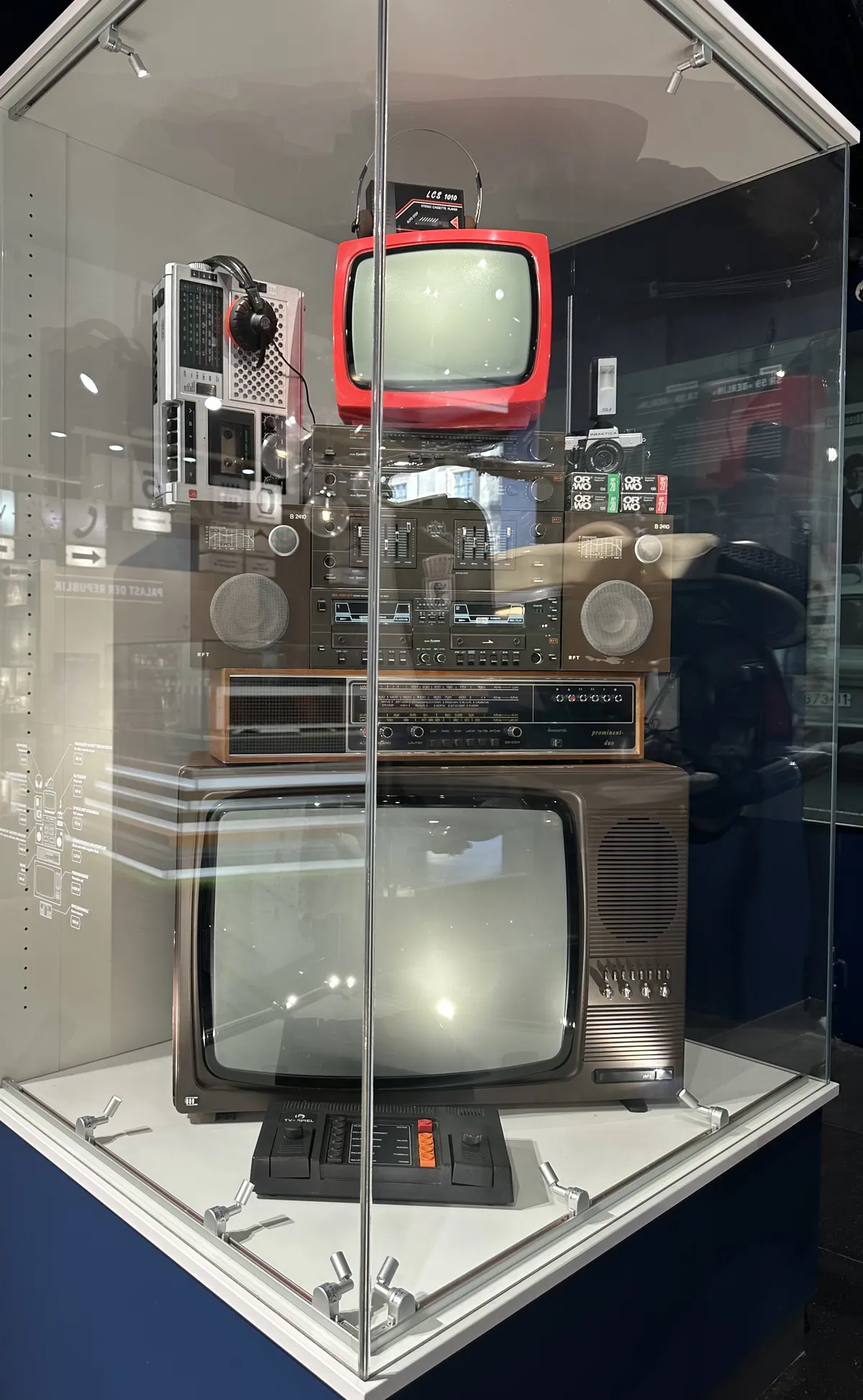 Some vintage tech
People who wanted to move from the east to the west had it harder than the reverse. There were strict controls on who got in and out, but mostly who got out. Western Germans were welcome because they brought in the hard currency the GDR needed. They scammed West Germans who wanted to see their families with a 1:1 currency conversion which was far from reality. Using the following kit, Stasi (Ministry for State Security) workers disguised as working for the Ministry of the Interior would check on every single passenger on trains before letting them in or out.
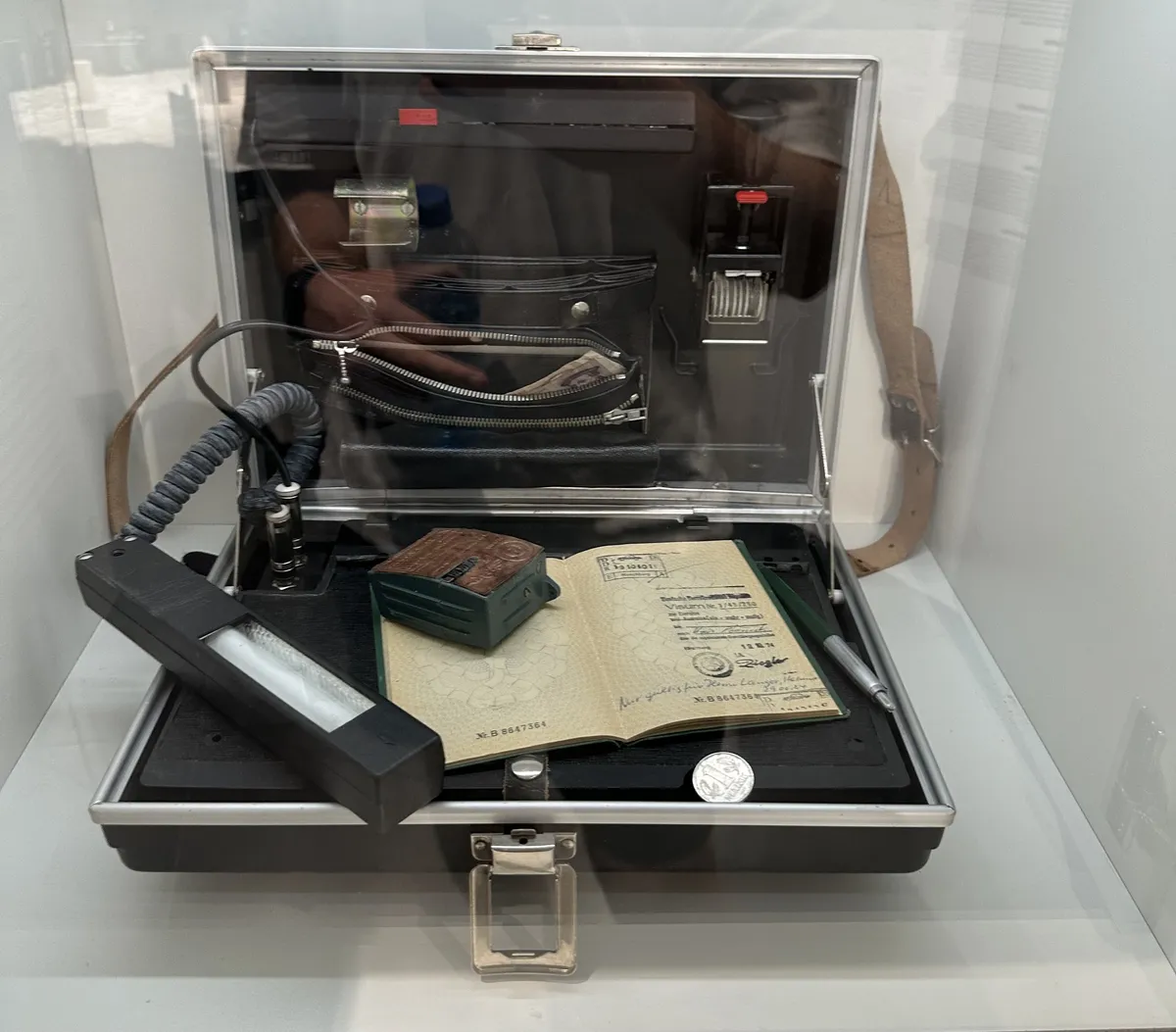 Suitcase containing a stamp, pencil, passport, flashlight, and a purse
The entire identity of the GDR was built around it being anti-imperialist, anti-fascist, and peaceful; basically everything it was convinced the FRG (Federal Republic of Germany) wasn’t. Party supremacy reigned and every party in its Volkskammer (parliament) was there for show. Disagreements were rehearsed and everything went by protocol. I was surprised to learn that the Socialist Unity Party only had 127 seats out of 500 towards the end. Whether they manipulated their elections or not, the outcome clearly didn’t matter as the Party knew best. So much for their anti-fascism. There was freedom of speech as long as you didn’t go against the party line or endanger the youth’s socialist morality. Even calling for socialism and not whatever the fuck the Party called socialism was going against the Party. At some point, the Party adopted the doctrine that socialism as it was in the East Block was Real Socialism, calling everything else utopian. Talk about shooting yourself in the foot.
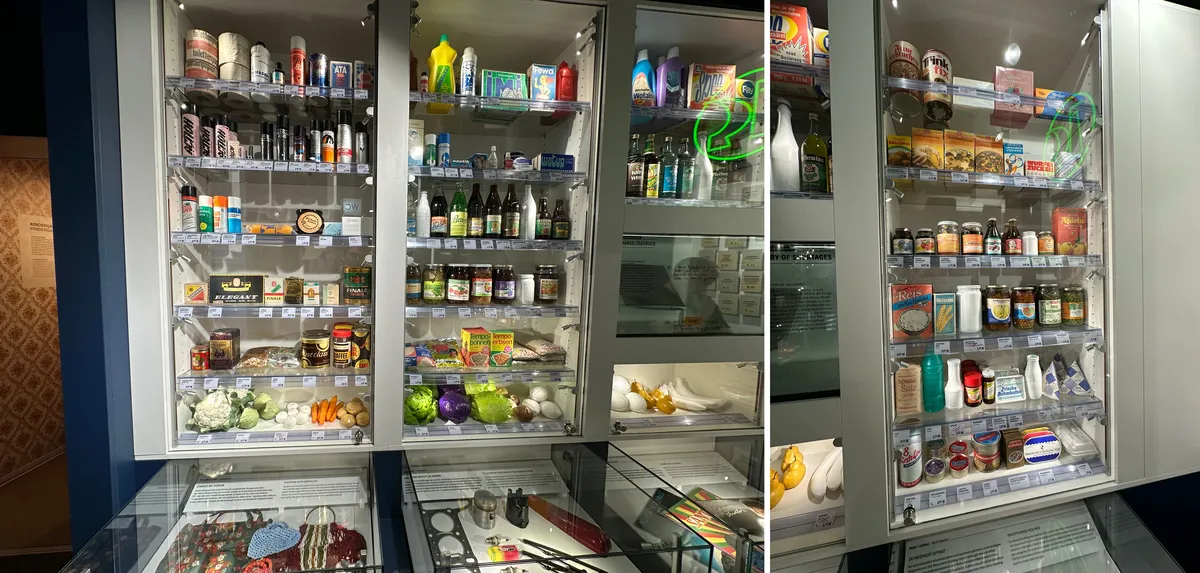 Supermarket shelves
The museum had recreations of items in a supermarket on display. People in the GDR still had to battle scarcity, but not as badly as other Warsaw Pact countries. They had the basic necessities, but technology, especially modern technology, was not accessible so they had to get creative. The GDR’s economics were… let’s say „creative.“2 There was this one policy they had of subsidizing farm produce where the exchange price for the farm produce from the farmer to the shop owner was higher than the exchange price in reverse. So a farmer could make bank by just selling to and rebuying the same from a shop owner.
For the GDR, instilling what they called „socialist values“ had to start young so they invested a lot in daycare and kindergartens. The focus lay on nurturing living together in harmony. In fact, their kindergarten coverage was significantly better than West Germany so that women could work. This wasn’t that benevolent—they had a worker shortage because of plummeting birth rates and young people escaping to live elsewhere. Plummeting birth rates, for whatever reason, didn’t stop the GDR from legalizing abortions, though. Below you’ll see how the museum recreated a typical GDR kindergarten which looks cute enough.
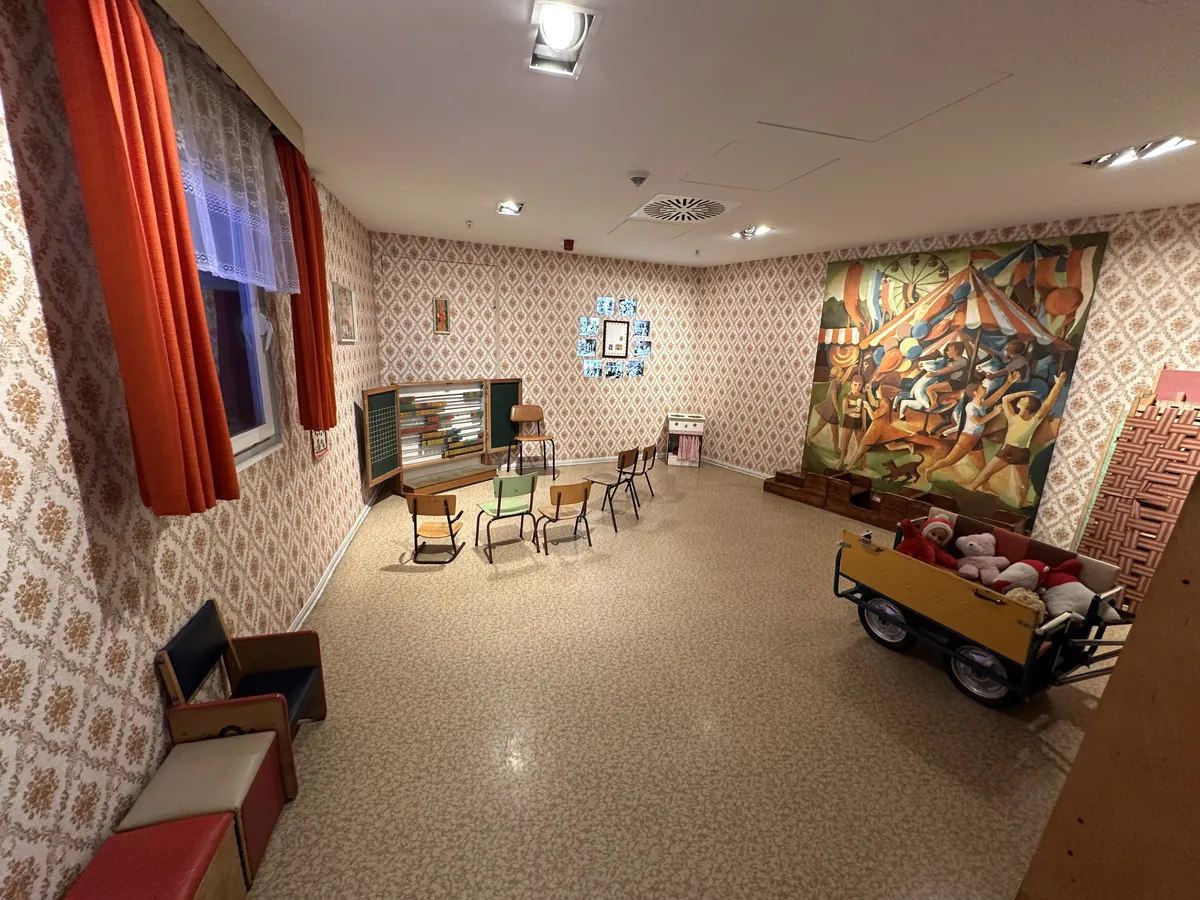 A kindergarten room in the GDR
As I said before, travel was heavily controlled. That means travel between the two Germanys as well as vacations. East Germans were free to travel within the Warsaw Pact, but not everyone could afford a vacation like that. So the unions3 organized affordable vacations for everyone workplace (you vacationed with your co-workers) which preferred families to single people (an incentive to breed, I guess). Only the cultural and political elite could get permits to travel to the West (beyond the FRG). Those who did, especially athletes, often tried to stay. For you as an East German receiving travelers, you had to keep a book of everyone staying in your building. If a person is staying for longer than three days, then you had to report that to the Stasi.
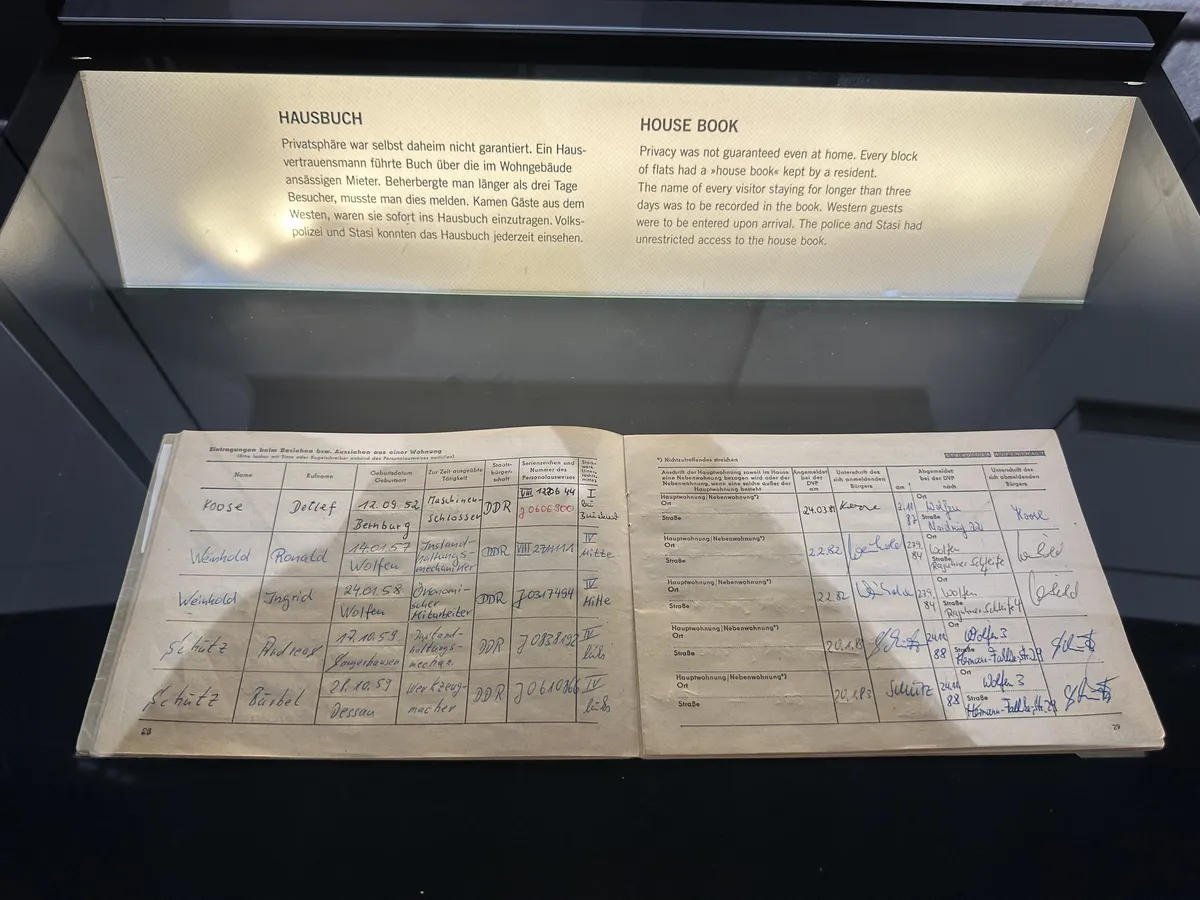 The housekeeping booklet
The best thing about this museum was its recreation of a typical Neubau apartment in those Plattenbau projects the GDR couldn’t build enough of. They had a garage (those who could afford it), a huge lift, a two bedroom apartment with a spacious living room, its own kitchen and bathroom. The apartment was really popular because it was the one area where I could barely take any kind of picture without someone being on it. Below you’ll see the ones that had few enough heads on them that I could blacken them out myself:
 From left to right: (1) entrance area, (2) bedroom for one person, (3) kitchen, (4) living area, (5) lift.
The last memorable room wasn’t part of the apartment complex. It was one of those typical rooms in which a Stasi worker worked in. The Stasi officially employed over a hundred thousand workers and had multiple hundred thousands of informants. A typical workplace room contains a typewriter, headphones connected to a listening system, a desk lamp, and some inexplicable electronics in the back next to folders. Most importantly, there is a picture of the Leader (Erich Honecker) softly smiling down on the worker as they work—the personality cult being a hallmark of fascism in everyday life.
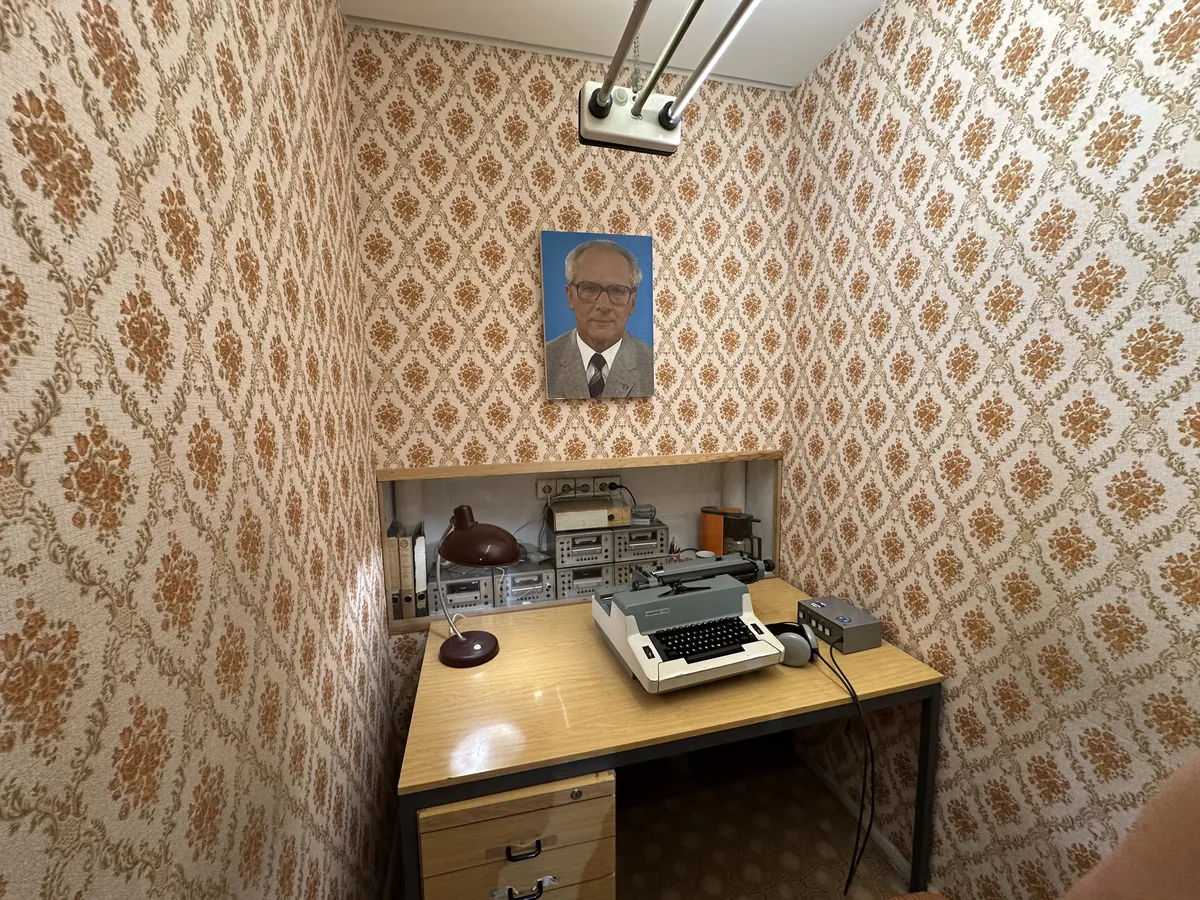
The GDR Museum was really cool in how it provided a glimpse of some aspects of life under the GDR. What I missed is a reflection on the continuities between the GDR and FRG in terms of social control. But of course, a museum like that is supposed to let us look at the bad past and help us see the good in the present to make us feel good about ourselves. There were many moments where I was taken aback by the snarky sarcasm in some of the explanatory text boxes all around the museum that basically read as „GDR bad, FRG is peak.“ I was hoping to see more than that—something provocative that says: This isn’t the best we can do. Something that questions the mediocrity of the FRG, but this is better than nothing, I suppose. We can work off what they provide in memory and critically reflect over the present ourselves.
The other museum would’ve been the Topography of Terror which was an outdoor museum that I wasn’t prepared for.↩
To be fair, economics as a discipline as it’s taught and practiced under capitalism in the West is not farther from myth than under the Warsaw Pact.↩
One of the few things the unions actually did since, you know, workers lived in socialism, so no need to barter with Sole Capitalist.↩