museums i recently visited iii
[!NOTE] This was supposed to be one post, but it grew so long that I had to split it up. Here are/will be the others.
The Jewish Museum’s exhibition that I discussed in my previous post took me around an hour to get through. With plenty of time left in the day, I decided to check out another museum on my list: the German Historical Museum. I was curious of the self-depiction in such a museum and what it would focus on. An exhibition about the role of nature throughout German history named „Nature and German history. Faith - Biology - Power“ sounded thrilling. With the way the exhibition was laid out, you’d start out with the earliest mentions of nature and advance on the scale of time as you walk through it. It was stacked with cool stuff, but I’ll try to focus on the coolest things that really stood out to me.
It starts in the High Middle Ages with Hildegard von Bingen who is honestly such an icon. Not only did she get a Rosalia song dedicated to her (titled Berghain no less), she also did a lot of work on the sick documenting the effects of certain herbs for certain illnesses. A lot of it is of dubious effect for the purposes it was admitted to patients from today’s standpoint, but her role in using the products of nature for healing is still important for that time period. For a woman and nun, she had a very authoritative voice at the time. It was noted in the museum that her correspondence with powerful figures had a very bossy tone, even when the recipient was the emperor. Nonetheless, she wasn’t villainized for it and her advice was taken with reverence. In a nutshell, she wad the OG white girlboss. The reason she was featured in this exhibition was in her symbolic drawing of the earth and its various components as you can see below:
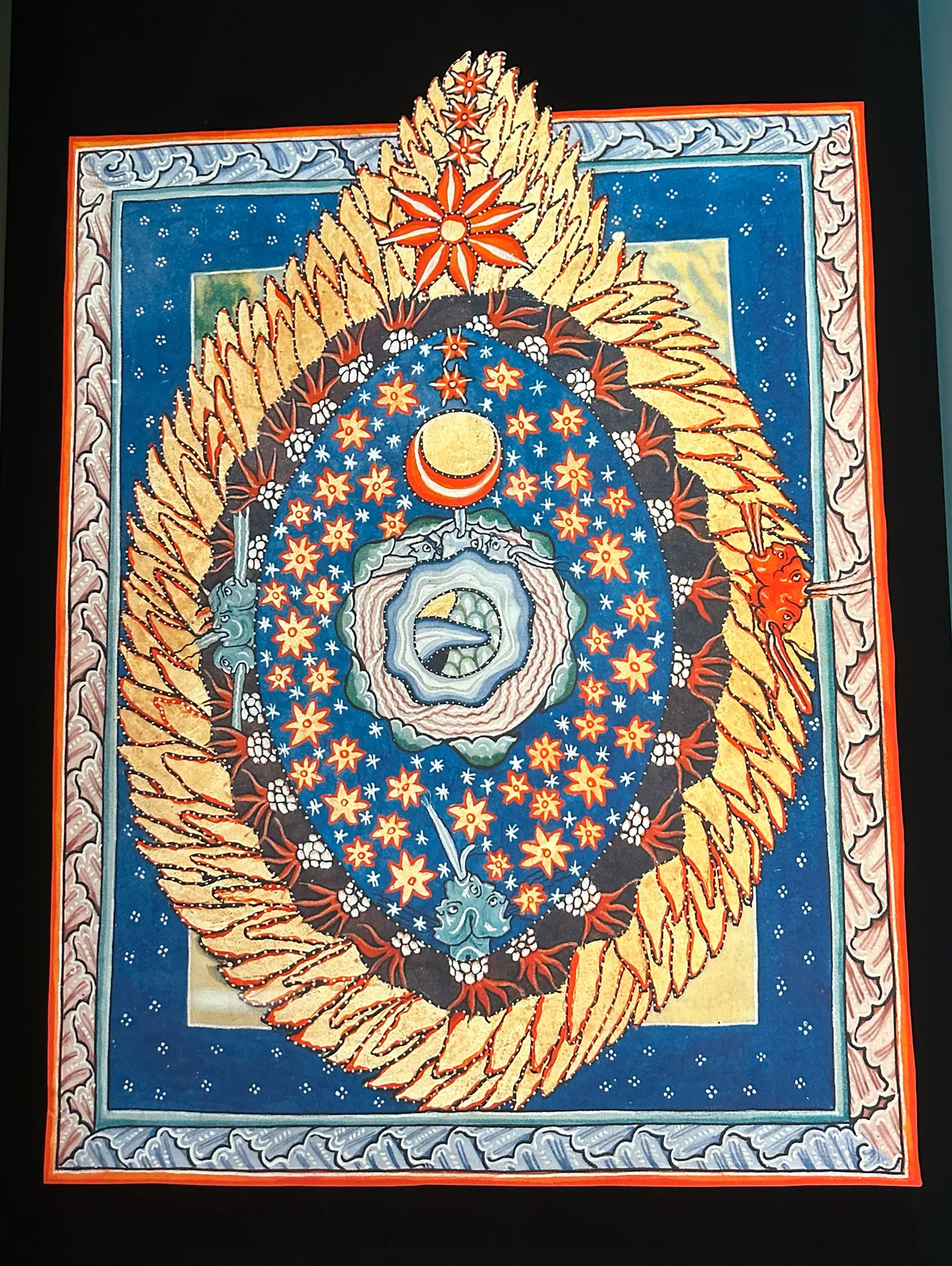 What constitutes the universe according to Hildegard von Bingen. I forgot what the individual symbols meant and didn’t take a picture of that, unfortunately, but believe me, it meant a lot of things :). It was common for artists during the European Medieval period to employ a lot of symbols in their creations and Hildegard von Bingen was only continuing that tradition.
The German word for nature wasn’t used much until the late 14th century and it was derived from the Latin word for nature. Because of the changing climate after the onset of the previous millennium, populations grew and with them land use change. That was what sparked interest in what was part of the human condition. Before that, there was little distinction made between nature (the world as it is) and culture (the world as it’s changed by humans). Nature was largely a manifestation of God’s gift to humans and sometimes she could be mean and wipe out a third of a continent’s population like in Europe around 1350. So humans had to live in tune with it which, unlike today, wasn’t a very conscious decision. It was the only way of survival. While this is technically still the case today,1 it’s a lot less so. Now people make the choice to be vegan, fly less, consume less, use public transport, recycle, incorporate greenery into architecture, but they don’t have to as not doing any of this doesn’t have an immediate impact on their life which wasn’t the case in previous eras.
What I found intriguing simply because it was mentioned (and it is but one example of this) is that medieval communities in Europe would collectively manage the use of resources so as to not exhaust them. Because of how essential fish was to the European diet, especially during Lent, communities living at lakes and rivers had to make sure that they don’t overfish them. They developed mutually binding rules that ensured the fish population remained stable across centuries, without privatization or the state. Swedish economist Elinor Ostrom did groundbreaking work on this topic for which she won a Nobel Prize that I think everyone should learn about it. Specifically, the example in the museum was of the Bodensee/Lake Constance which borders Germany, Austria, and Switzerland.
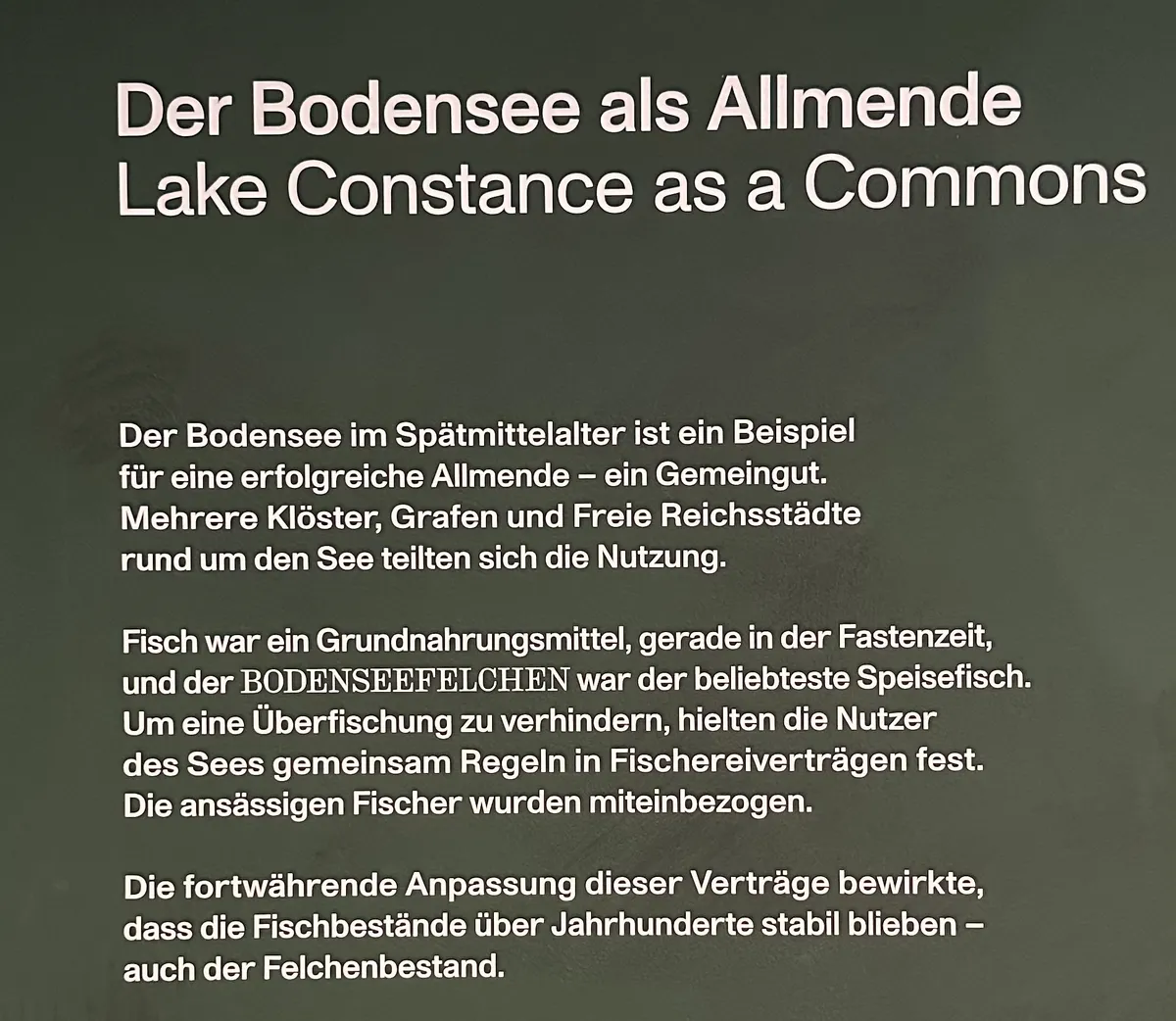 Deepl translation for your convenience: „Lake Constance in the Late Middle Ages is an example of a successful commons—a shared resource. Several monasteries, counts, and free imperial cities around the lake shared its use. Fish was a staple food, especially during Lent, and the Lake Constance whitefish was the most popular edible fish. To prevent overfishing, the lake’s users jointly established rules in fishing agreements. Local fishermen were involved in this process. The ongoing adaptation of these agreements ensured that fish stocks remained stable for centuries—including the whitefish population.“
With industrialization came a lot of technologies that defined nature as a resource to be capitalized on. The steam engine, railway, and factories changed the scenery so much that a new movement came about to protect nature from overuse. Conservation was so big that it was basically what the Nazis rallied around. From eugenics to racial purity, the Nazis took on defining what’s natural and actively redefined as was necessary for their needs to vilify the unwanted and „cleanse“ Germany from it. This culminated in the Nuremberg Laws for the „protection of German blood.“ They demanded proof that someone was biologically German which is a wild request since this can’t be proven in the labs. So what they resorted to doing was checking whether someone was baptized or not, using baptism certificates (Taufbescheinigungen). Likewise, when the Nazis deemed something necessary for the betterment of Germany, they’d try to brand it in a way that would still make it look „natural.“ For example, when Hitler commissioned building the Reichsautobahn, he hired people responsible for planting plants native to Germany alongside it to make it fit better with the scenery. Obviously, the Party knows best and all anyway. Still, abiding by some cultural norms at the time while upending others made their social control easier than it would’ve been, had they used sheer force against everyone and not just „undesirables“ like political, sexual or racial „deviants.“
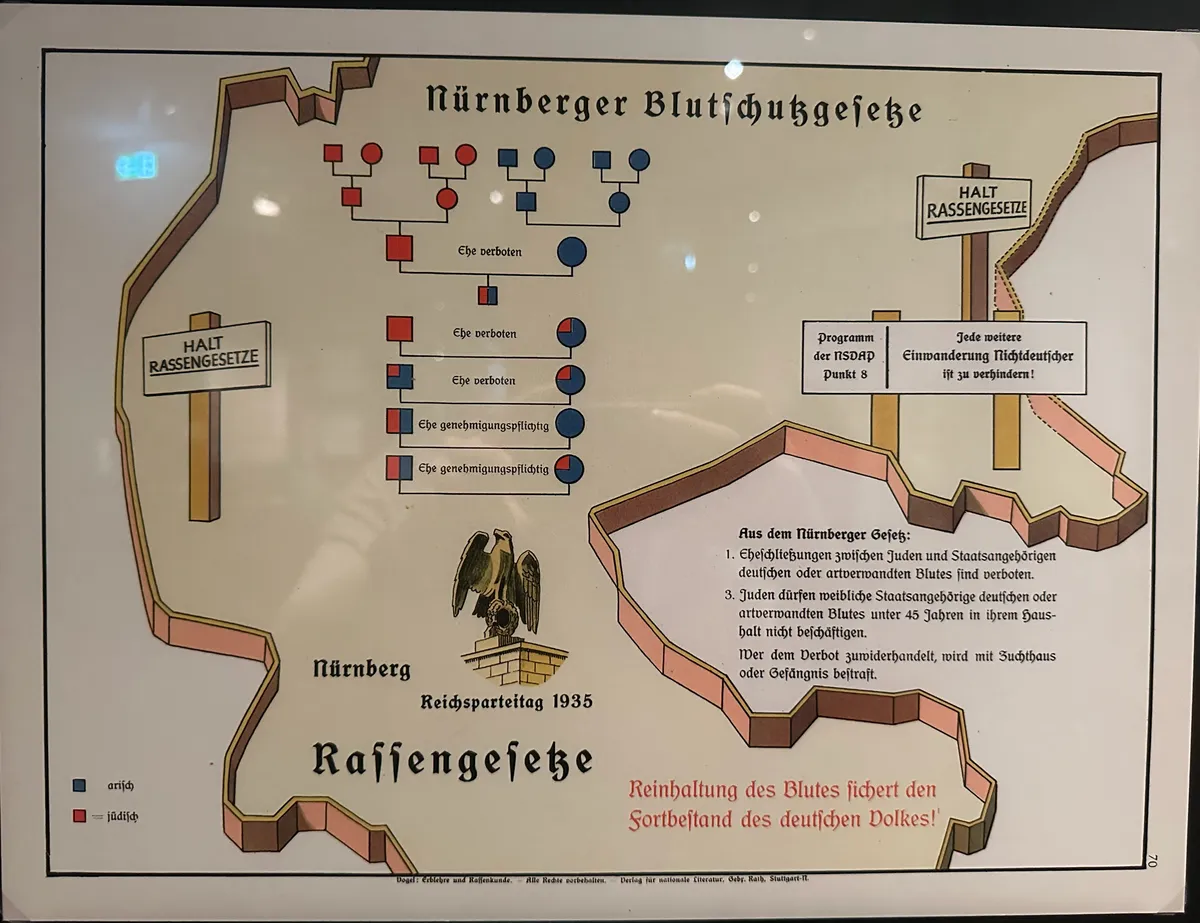 This is a visual layout of the Rassengesetze (=racial [purity] laws) in Germany, passed in 1935. The text in red at the bottom right was the legitimation: „Keeping the purity of [our] blood ensures the continuity of the German people!“ At the left is the meaning of the box colors at the top: blue means Aryan while red means Jewish. Marriage between half-Jews and Jews or three-quarter Jews required approval, everything else was illegal. I hate how they wrote s like it is f.
The second exhibition was very boring in comparison (and my legs were screaming at me by then to sit the fuck down). It discussed the history of the museum itself, how it came about, endured the German Democratic Republic (aka East Germany), and changed into what it is today after the fall of the Berlin Wall in 1989. The museum basically had a blank check with a lot of funding in the ‘90s to make itself happen and the team was completely free in directing their exhibition as they wanted. There was a lot of political will to make this museum happen, judging by the funds that made them able to buy plenty for a permanent exhibition and hire 100 employees beyond the core team.
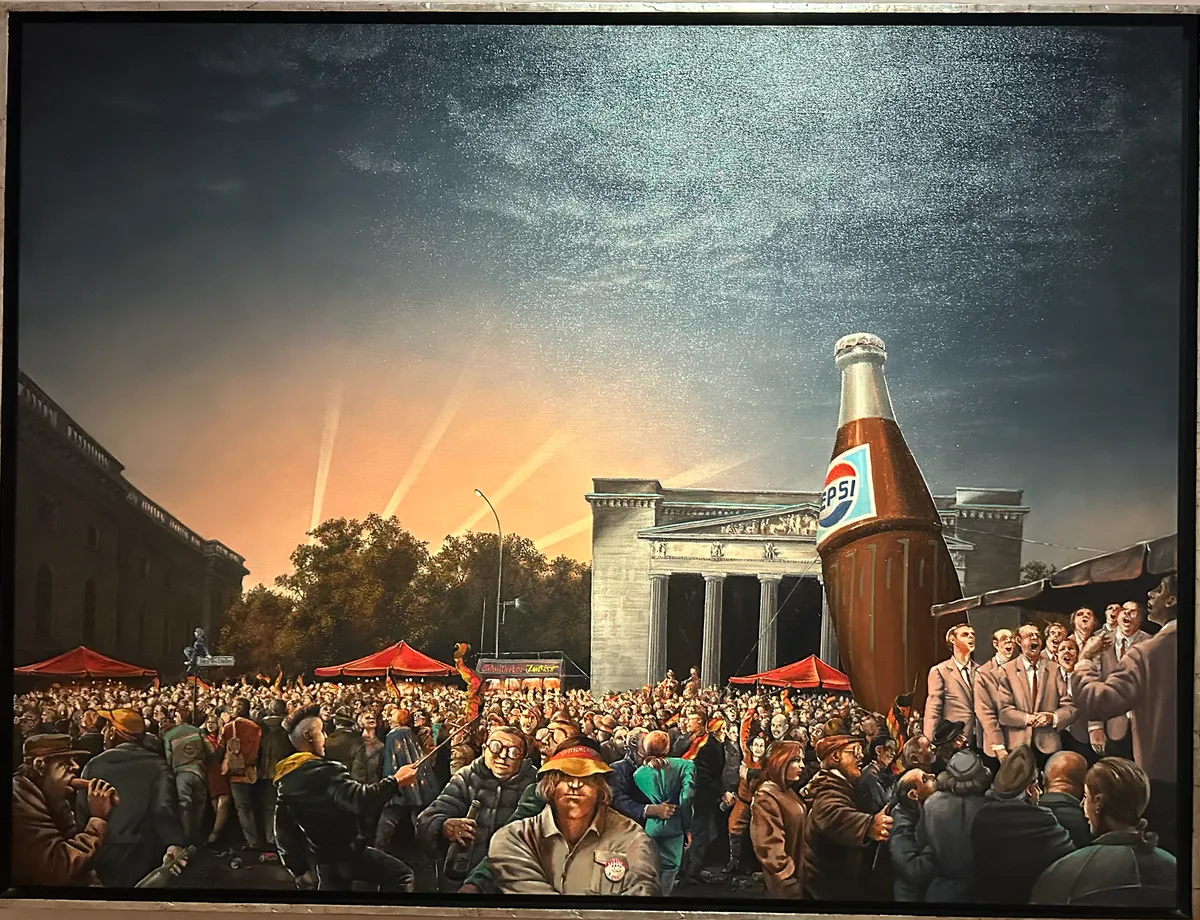 This painting that was pretty much in the exhibition’s entrance area stood out to me. It was explained somewhere outside the bounds of the attached image that this was supposed to picture the triumph of consumer society over communism. In the image, you can see people dancing and celebrating as one huge Pepsi bottle statue is raised in front of the Brandenburger Tor/Gate, with Pepsi being the symbol of consumption. This End of History talk was what ruined this exhibition (and the GDR Museum that I’ll discuss in the next post) for me (in addition to my leg pain of course). Its snarky tone was often portrayed as fact and not a political agenda pushing the idea that the best was achieved and anything better is futile, because—and you’re of course made stupid for thinking otherwise—there were only two political systems on the table in modernity and those were capitalism (and liberal democracy) and capital-c Communism. Since the Soviet Union collapsed, clearly capitalism has won and is therefore the best. As if the choice was ever, at any point, only between capitalism and Communism.
One thing that stuck in my mind and that I discussed a bit in my post about the Vienna Museum was that a lot of cool institutions built in the interwar period were co-opted by the Nazis to do nazi things. In Germany, those were stadiums which were built and used in the Weimar Republic. A lot of diverse organizations were involved in organizing activities in them, however, after the Nazis took power and ordered the Gleichschaltung, those spaces were co-opted for propaganda purposes and only Nazi organizations like the Hilter Youth could use them. They remained the center of Germany’s sport culture, although now single-handedly controlled by the Nazis. This is another example of mirroring of the old in the new that Naomi Klein discussed in Doppelgänger. Sport remained central to culture but it resembled little of what it once was before the Nazis.
This was a cool museum, especially the first exhibition. It’s unfortunate that my leg pain made me less attentive to the second exhibition despite my breaks in-between, but I needed to lie down by then. But, well, it was nice nonetheless.
Climate change is the product of abandonment of the mutual respect between humans and nature among other things.↩