museums i recently visited ii
Note
This was supposed to be one post, but it grew so long that I had to split it up. Here are/will be the others.
For my trip to Berlin, my plan was to check out some museums there about German history and Jewish culture, and of course some sightseeing. For my first museum in Berlin, I decided to go to the Jewish Museum. I didn’t take any pictures there because it felt like a place of mourning. Maybe it’s my upbringing that made me not take a single picture in something that felt like a funeral or maybe it was my disappointment in what I saw. Either way, no pictures from the place, but lots of thoughts. The museum had one focus: the Holocaust. It bothers me that Jewishness is again singularly defined by what happened to Jews, focusing on them as objects of history rather than agents in their own right. There was nothing about their vibrant and long history in Europe (specifically Germany) and I was so, so deeply disappointed to see the Jewish Museum be basically a Holocaust museum. It was a pretty exhibition, don’t get me wrong. The museum building itself was a very opinionated art piece in and of itself. I would still recommend going there and seeing the artifacts of Holocaust victims, but don’t expect to learn anything about the Jewish people in Europe that you haven’t heard regurgitated over and over in traumatizing documentaries in school (if you went to school in Germany or Austria, that is). Not even Zionism.
Jews have a long history in Europe that didn’t start and end with the Holocaust. Their demonization shouldn’t be what defines them, but how they adapted to it, how they built great things in spite of racist white fucks wanting them dead at every turn. It boils my blood that this exhibition (and Germany’s memory culture more specifically) reduces them this way. There was nothing about their migrations to escape hellish German antisemitism, nothing about the Pale of Settlement there, nothing about fierce Jewish anarchists (a lot of them women!) conspiring to bring down tsarist Russia, and nothing about the Yiddish language being a language of resistance. There was nothing about the Jewish Labor Bund building a whole subculture of social services, about its emancipatory projects for workers, peasants, women, and children. If this museum was called „The Holocaust Museum,“ I would be pissed for other reasons,1 but I’d understand the sole focus on extermination. It hurts to see a people reduced to a grandiose act of cruelty perpetrated against them and not who they wanted to be (and were!) despite all odds being against them. Their long history of defiance of making the Here better for themselves and everyone else was lost in this museum and it breaks my heart.
It’s safe to say that I left the museum sad, albeit for a different reason than the museum intended. Maybe that was just the free exhibition because the second floor was locked down when I was there. I went in expecting to pay for my ticket, but the staff told me entry was free until September. I would’ve happily paid to see the second floor if an exhibition that discussed more than the Holocaust existed there at the time, but none was there.
Since we’re on the topic of the Holocaust, let’s discuss a group that, if it ever came up in school, was only mentioned in passing. „Oh, yeah, and the Nazis also persecuted homosexual and trans people for being homosexual and trans people. The End.“2 With Ava and her wife, we went to the touring exhibition „Living in danger. Queer people 1933-1945“ by the Magnus Hirschfeld Foundation held in a church in Cologne, so I want to take this as my chance to spread the word a little. I can’t lie, attending an exhibition about LGBTQ+ life in Nazi Germany in a (Protestant) church was not what I was expecting. It’s allegedly because the pastor’s gay. Whatever!
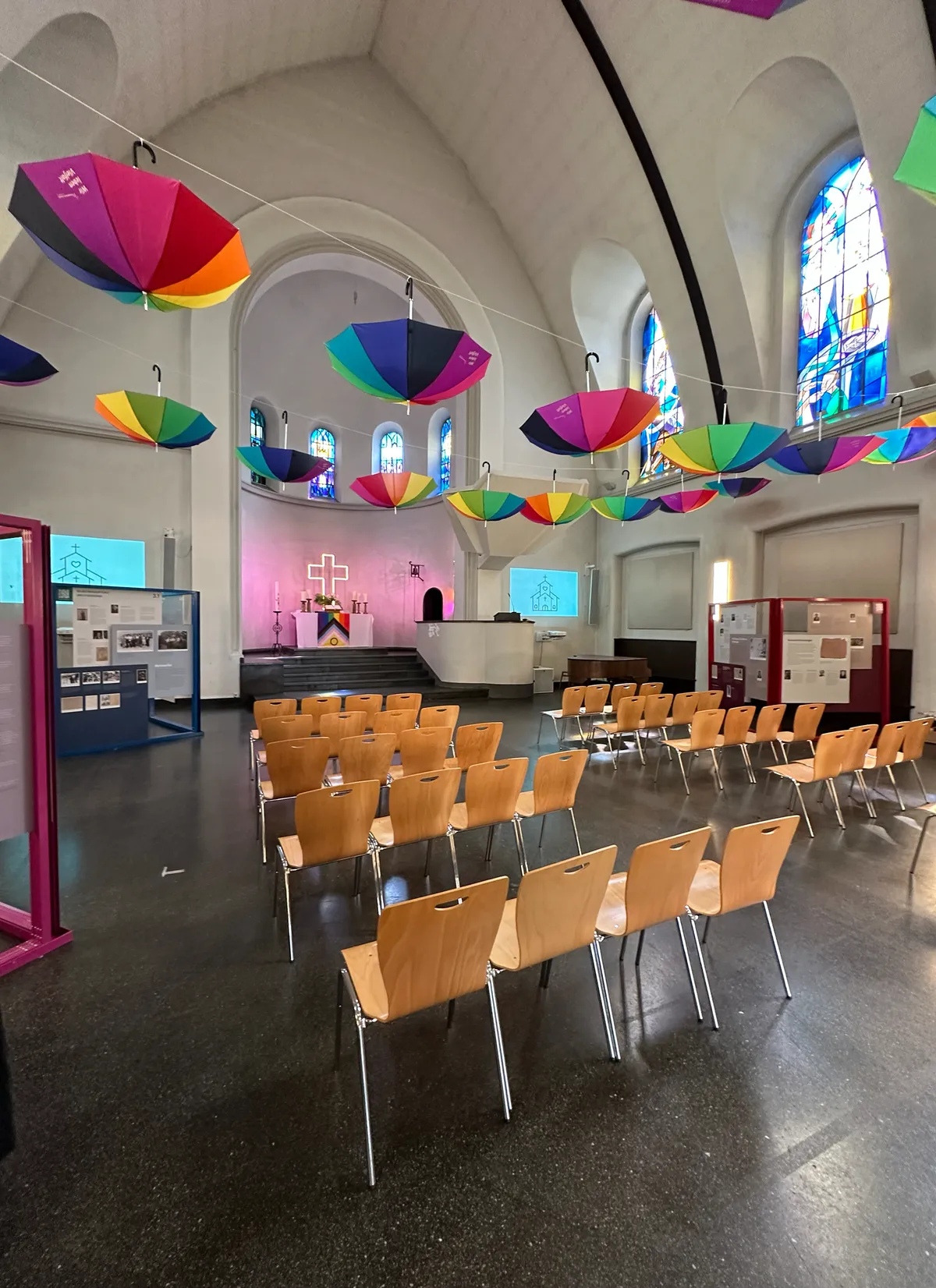 Especially that pride flag on the altar with the crucifix on top was super confusing. Be gay, be crime or be neither, dude. I hate believers who pick and choose.
This exhibition was text-heavy with specific foci on aspects of queer life. It covered living in the underground, blackmailability, civil courage, lavender marriages, dominating as the dominated (in concentration camps), lesbianism as a circumstantial criminal act, issued passes by the Institute of Sexology3 that allowed trans people to apply for a name and legal gender change in the Weimar Republic, the persecution of trans women under the same law that criminalized homosexuality, the continued criminalization of homosexuality after WW2, and the resistance against it in the Federal Republic of Germany (aka West Germany).
The creators of the exhibition used stories of individuals to guide their exhibition’s larger story using people who we have on record were queer because they were persecuted for it. Some of them have funny stories that resemble current public figures such as Jutta Rüdiger who reminded us of Alice Weidel. Reading her description again, she sounds like if Alice Weidel (AfD-leader and neo-Nazi) was also pushing the trad-wife lifestyle (Maybe she is? I don’t keep up with her). Jutta Rüdiger was a lesbian very active in various Nazi institutions such as the Bund Deutscher Mädel. She dedicated her life to the party and then lived on with her co-worker Hedy Böhmer in a relationship until 1991. Her lesbianism was known, but her status in Nazi Germany protected her from homophobia. There was another gay woman who was a screenwriter and activist for liberal causes before Hitler’s ascent to power. She dedicated a play to him which he didn’t reciprocate (he didn’t thank her for it). Her play/screenwriter career didn’t survive the Gleichschaltung if I recall correctly. That was hilarious.
After the coup against Ernst Röhm (the SA-head who was gay), the Nazi regime used the queer purges to make themselves more palatable to conservatives (mainly Catholics). However, the law’s insistence on explicitly punishing sodomy/anal penetration made it hard to legally prosecute those who claimed to only have masturbated together. The Nazis then passed a more stringent law that prohibited all male-to-male sexual relations, though not lesbian ones. Lesbians were still punished as homosexuals under section 175 of the German criminal code if they were implicated in a different crime. As a consequence, there were more gay and trans prisoners in the first concentration camps (Lichtenburg and Columbia-Haus) than political prisoners (socialdemocrats, communists, and some liberals).
Within the concentration camps, some gay women managed to protect themselves by taking on overseer roles and sometimes even taking on the role of instituting punishments on their fellow inmates. I can understand why one would choose to take on such a role in the precarious position that a woman occupies in society, let alone as a gay woman in a concentration camp. That doesn’t mean I have to respect that choice or see it as a valid one. Those women who chose that path were self-centered assholes either way.
After the war ended and the camp inmates were freed, many turned toward the newly founded victim associations, however, queer people who were imprisoned on grounds of being queer were turned away. Homosexuality was still criminal so queer people had to help each other. The strict section 175 was retained for decades to come and the victims didn’t even get a formal apology for internment in concentration camps, accusations of homosexuality aside. This goes to show that the Global North viewed what happened in Nazi Germany as something legitimate taken to an extreme (seeing how concentration camps were inspired by British internment camps in South Africa and reservations for indigenous people in North America). There was one student who was defamed for fornicating with men, robbed of his degree and thus his future. He sued for lifting the discriminatory law against homosexual relations, being rehabilitated (getting his degree back), and compensated for the time since his conviction, which the museum people considered „utopian“ even by the 2017 German law of rehabilitation—an appalling comment! If even that allegedly progressive law doesn’t make victims of legal witch hunts like that entitled to what that student demanded, then the law is bullshit.
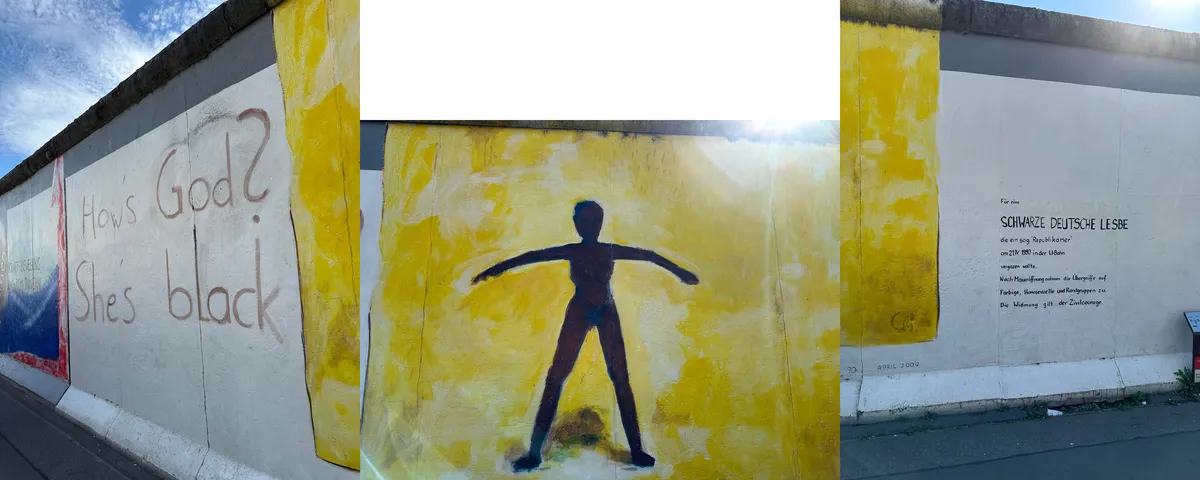 A painting at the Berlin Wall Memorial dedicated to all the victims of the higher rates of racism and homophobia in East Berlin compared to West Berlin that affected racialized and queer minorities in West Berlin after the fall of the Berlin Wall. I honestly don’t know what to think of this, but I just thought it’s worth putting out there since I saw it in Berlin.
What was confusing throughout this exhibition was the lack of consistency in gendering trans people. There were instances where the pronouns matched the gender, but they often just used the pronouns for the gender assigned at birth. Ava’s wife (the historian among us) said that maybe they didn’t want to project today’s preferences on historical figures whose preferences were unclear. She said that before we got to a trans person mentioned where the gender matched the pronouns, though, so we left the exhibition unsure of the reason for the inconsistency.
Overall, I enjoyed the second museum about the Holocaust more because it was more honest about what it would contain. The historical characters had more depth and were multidimensional. I enjoyed seeing more of them than their remnants like their character peeking through the text. I hope to find a museum on queer history in Germany and/or Austria more broadly, such as life under the monarchy, the effects of industrialization on queer life, the relationship between the feminist and queer movements in continental Europe, etc. If you know of an exhibition you enjoyed that is in those and about those countries, let me know—I’d really appreciate it!
Because it would focus on only one subgroup being systematically exterminated with the rest essentially being reduced to a footnote at best.↩
I heard from my exhibition companions that what I heard about the gays and dolls in history was still more than they did (they’re about a decade older than me). They don’t remember them being mentioned, even in passing.↩
Magnus Hirschfeld did incredible scientific and activist work on various queer topics. As a (Jewish) gay man, his lifelong wish was for queerness to be seen as normal and not a choice so he founded the Institute of Sexology in Berlin with friends to study queerness medically and even performed the first sex reassignment surgery in the world!↩