museums i recently visited i
Note
This was supposed to be one post, but it grew so long that I had to split it up. Here are/will be the others.
In July, I visited the Vienna Museum which reinvigorated my love for museums which is why I decided I needed to visit more museums this summer. The Vienna Museum was such a brilliant start for me because a) the permanent exhibition which encompasses three quite large floors is free and b) I could easily get a companion for the exhibition (free entry makes this more digestible for those not really into this). For a free exhibition, this one was pretty big and we didn’t finish it in one go.
So what did we see there? The first floor covered medieval Vienna, with a model of the city and a timelapse of its growth. It contained a lot of artifacts from that time period, including lots of knight armor and weaponry. The second floor was way more interesting in my eyes. They had models of Vienna before and after building the Ringstraße which showcased the total overhaul of the city center in the span of just three decades. I also loved spotting synagogues in the models (they were made nearly invisible because of reactionary laws at the time). There were lots of cool clothing items and mannequins showcasing all the layers (aristocratic and bourgeois) women wore at the time. This floor was quite feminist in that it made an attempt at addressing the absence of women in some fields and their overrepresentation in others. Additionally, it discussed the plight of workers and especially women in light of the Industrial Revolution.
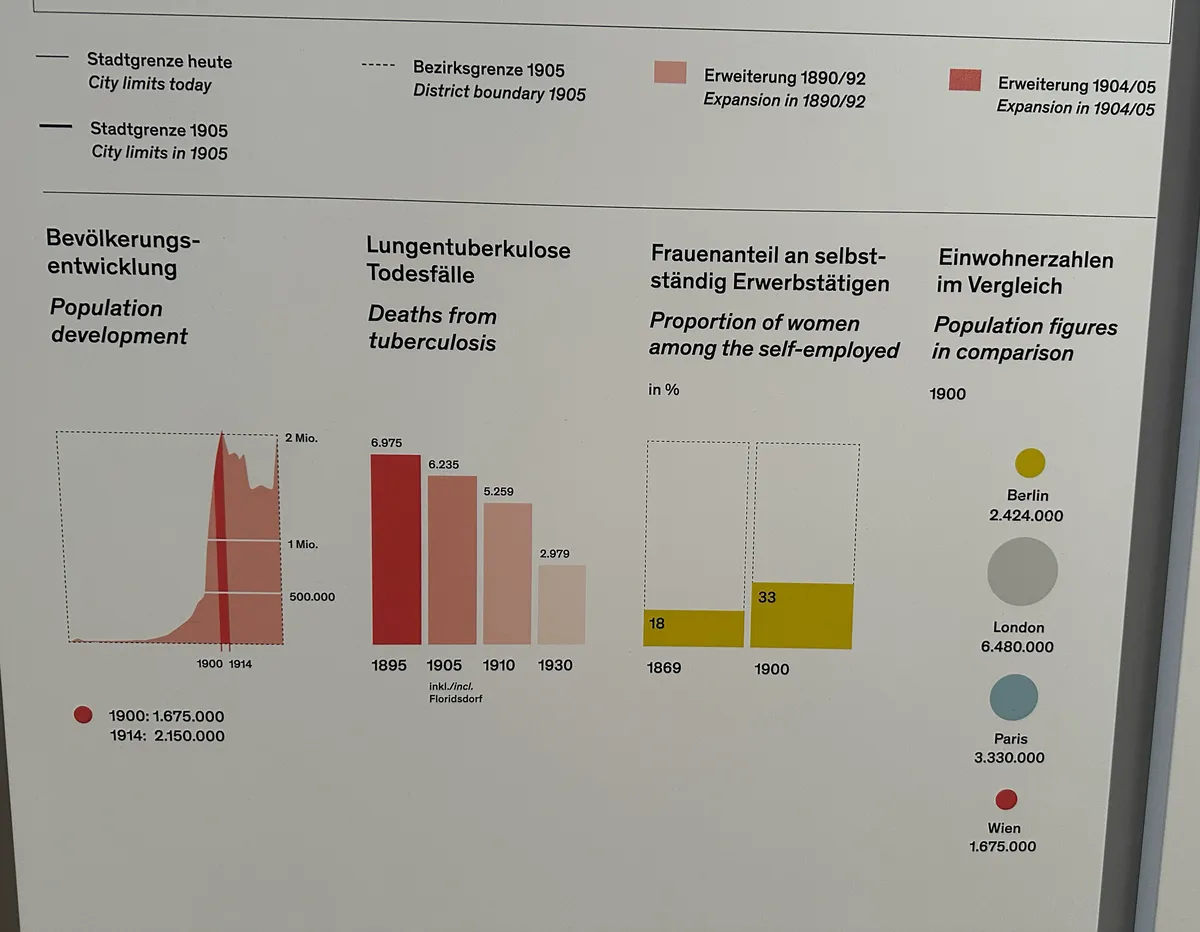 Women made up a third of the self-employed workforce start of the last century.
One of the statistics that surprised me was the percentage of women working independently at the start of the last century. In school, we only learned how during WW1 women basically took up every job there was because men were busy fighting someone else’s stupid war. Of course, it was unprecedented for the Second Sex to take up nearly all of wage labor jobs, but there was little mention (if at all) of the role women played in the workforce (even if not the wage labor force) prior to the necessity of enlisting them in the home front (as the civilian contributions to the war effort were called). Their reward for doing unpaid domestic labor in addition to paid wage labor was the right to vote and a retreat to domestic life in the first republic. That’s where the curriculum’s story ended.
The museum contained lots of posters for various causes—from ads to election campaigns. Really known painters like Gustave Klimt were commissioned to create many of these and it was how poor people got to see some of the work those artists did. If ads today looked like ads in early 20th century Vienna, you wouldn’t catch me complaining about them. Just take a look for yourself:
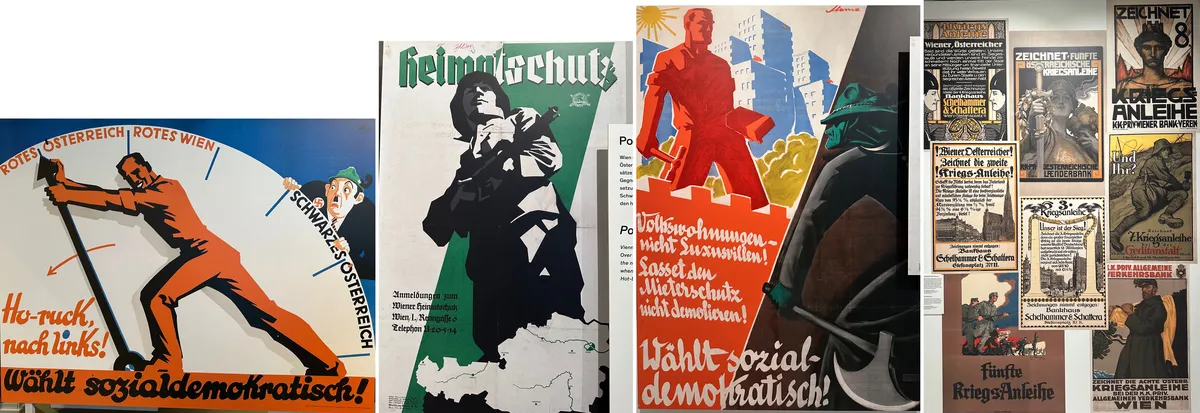 From left to right: (1) campaign poster of the Socialdemocratic Party for national elections, (2) campaign poster to get young men to enlist in the austrofascist paramilitary wing of the Austrian People’s Party, (3) campaign poster for the municipal elections in Vienna about preserving tenant protections, (4) various street ads, usually begging for civilians to buy war bonds.
Aside from ads, there were lots of images of Viennese public life in Red Vienna. The city between 1918 and 1932 was every leftist’s dream then and (weirdly) now (especially in North America, it seems). Red Vienna commissioned huge housing projects that were very self-contained. They contained parks, kindergartens, elementary schools (at least in walking distance), day care for working moms, and info points for new moms. They provided health services for new borns and new moms for free. They even sent welcome packages for newborns because socialists then considered it an abomination that children be born and nursed on newspaper paper. Public swimming pools, sports activities for kids and adults, public transportation, and so much more was built during that short time period in this city.
Some of their projects like the sanatoria for kids laid the unfortunate groundwork for Aktion T4 in which the Nazis exterminated so-called „life unworthy of life“ because the kids were already institutionalized. They forcibly euthanized kids, lied to parents, and faked the kids’ death certificates. Just because the Nazis did what they did with existing infrastructure doesn’t mean that the idea behind building that infrastructure was evil. I think there’s still a conversation to be had about the data collection that we allow government and government-like institutions that corporations to do that would make cruel, horrific acts the Nazis could only dream of executing in the precision possible today a reality.
This was a cool museum that I’m sure I’ll be revisiting later down the line. It was packed with so many interesting tidbits that my brain couldn’t really keep up with. Museums are really cool in general and we shouldn’t be turning them into escape hatches from heatwaves like the clown EC is telling people to do instead of banning fossil fuels, investing in non-consumerist third spaces with AC, and greening our cities. For this museum specifically, I hope it remains free of charge as I think everyone coming to Vienna should see it, and what better way of keeping a museum accessible than keeping entry free?